
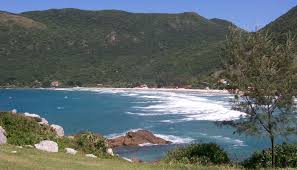
The city of Florianopolis is the capital of the Brazilian state of Santa Catarina, located on an island 820 meters off the mainland from its closest point, the city occupies the entire island and connects to the mainland via two parallel running bridges: Colombo Salles and Pedro Ivo Campos via route BR-282, a third bridge, Hercílio Luz, is closed to traffic. The island has subtropical humid climate, with an average humidity of 80% and year long rain falls, which contributes to the perfect conditions the city has for tourism and travel. 
The city’s named after Floriano Peixoto, 2nd president of the then nascent Brazilian nation. Between 1893 and 1894, Peixoto squashed a military attempt at secession in the states of Río Grande do Sul and Santa Catarina, whose capital went by the name of Nossa Senhora do Desterro (Our Lady of the Exile) or just “Desterro” for short, before the conflict. After Peixoto brought back both states under Brazilian control, the Santa Catarina capital was renamed Florianópolis, as punishment for the catarinian role in the rebellion. The island was originally settled by Portuguese bandeirante explorer Francisco Dias Velho, in 1673, and ascended to the category of village by 1714, then again to city in 1726 by the Portuguese Crown, held then by King Joao V. 
According to the census conducted by the IBGE (Brazilian Institute of Statistics and Geography) in 2010, the city is currently home to at least some 421.203 individuals in an area of 433.32 km2. The city’s main economic activities are the industry and services industry, with many IT firms based out of it; and the tourism industry, which receives an estimated eight million visitors according to the State of Santa Catarina’s official website, makes an annual average (statewide) revenue of US $777 million, which is £503 million.
Tourism on the island 
The capital of Santa Catarina has at least 88 large hotels and over 200 smaller Bed and Breakfasts and Inns and with access to over 42 different beaches, it’s an enviable vacation destination year round. Some of these beaches including beautiful Joaquina beach, which has been a Mecca for surfers since at least the 1970’s and is home to several important tournaments and offers some of the best tourist facilities in the region, there’s also Barra da Lagoa, that has very few touristic developments so it’s more attuned with nature; and the world famous Praia Mole, two other famous surfing hotspots include the beaches of Campeche and Ingleses.
The three bridges that connect to the mainland 
Florianópolis is famous not only for its beaches, but also for its huge sporting scene: it’s home the Association of Surfing Professionals (ASP) World Championship Tour’s only South American stop, the city has been the venue for the tournament on four different occasions. Floripa, as the locals call the city, is home to two major soccer clubs, Avaí FC, whom play in the second division, and Figueirense FC, that play in first division rank. The island is also famous for being the birthplace of sandboarding, the sand dunes near Joaquina beach, for example. There’s also a Rugby club, with both men’s and women’s teams called Desterro Rugby Clube.
Fans of Figueirense FC 
Over the last few years, there’s also been a growing poker scene with large tournaments being held at some of the local casinos. One of largest brand names in online poker, Poker Stars, has hosted several of these and, in fact, will be holding a huge party for their VIP Club on November 14th in the City. There will be drinks, food, famous guests, professional players looking to make a fortune and a name for themselves and of course, poker. You might even have the rare chance to see one of brazilian soccer’s greatest prodigies: Ronaldo Nazario, who played in the winning National Team in the USA 94 World Cup, as well as with legendary spanish club Barcelona FC, where he scored an impressive 34 goals over 37 games in his only season with Barca, won a £30,000 purse last year in a similar tournament in the Bahamas.
Ronaldo: the man, the legend 
Floripa is also an education hub: it’s the home of several institutions of higher learning (in case the great surf weather isn’t enough to entice you to visit) to seven major universities, including the Federal University of Catarina and the Federal Institute of Education, Science and Technology. Who know? You might just fall in love with the city and move to study for a years, or maybe settle down and start a new life in Brazil’s fastest growing, most beautiful city.
Federal University of Catarina campus 